“Maybe later today I will carve poetry into the riven bark of the weeping willow in the garden of my childhood home. I might go to the shore, smash my hurt on the rocks and watch my tears become the ocean. Perhaps I will sleep in the forest and wake to a world of talking animals. I might gather with others around a fire telling stories of seeds and bones buried deep – or fill ancient caves with laughter and song. Or I might just be here, quietly at my desk, sipping tea, waiting for the sun to rise. This is the writing life.” ~ Beth Kempton, The Way of the Fearless Writer: Ancient Eastern Wisdom for a Flourishing Writing Life
“New year, new you.” How many times have we heard that repeated since the start of the month? Soon enough it will fade to the background like an insect’s droning buzz– ignored until it’s finally gone. I stopped writing Morning Pages for several weeks. What became a habit for an impressively long time suddenly became a nuisance. And I’m okay with that. I think at some point most creative thinkers want to take a step back to focus on something other than a reason to create. Or at least the time and space to create other things without reason.
I set aside my writing and reading to revisit sketching, doodling, and dabbling in truly sublime metallic watercolour paints. I reconnected with my old friend knitting whenever the mood to play with yarn happened to strike. Creatives hear all the time that they must push through a lack of motivation to keep honing their craft, that a lack of motivation equals laziness. I used to believe it, but this current version of me disagrees. Then again, there’s no pressure in my current life to create for a living. I’m not supporting myself or a family with my writing and thank goodness because I would be terrible at it. Completely unreliable. I have deep respect for anyone who does so on a daily basis.
Drawing and painting is not the sort of creative outlet I’m particularly good at and knowing that provides the freedom I had as a child to dive right in. I’ve always loved playing with pencil crayons and crinkly paper and pretty stickers. Long before I knew I was a writer, I felt the urge to make things out of scraps without any kind of purpose other than the pleasure of holding those creations in my small hands. We somehow lose that feeling along the bumpy way, don’t we? Why wouldn’t we when we’re fed catchphrases like “new year, new you”?
Somewhere between the start of the year and today when I reopened my Morning Pages notebook, I decided the old me is doing just fine, thank you very much. The first sentence I wrote was well, hello, you, as though welcoming myself back to a comfortable room. Then I proceeded to handwrite two pages of jumbled thoughts. Sometimes hiding within a jumble of nonsensical sentences is the sliver of a story. Sometimes it’s just pure nonsense. Thinking about nonsense eventually made me look up the dictionary definition of the word. Here’s some synonyms: absurdity, babble, baloney, bunk, claptrap, craziness, drivel, folly, foolishness, gibberish, madness, mischief, rubbish, silliness and trash. Of all those words mischief is the clear standout. Nonsense equals mischief. Mischief equals fun.
In the process of creating something out of nothing the room can feel overly crowded at times. The walls need a moment to shift–to allow fragments to escape and others to remain. These are the quiet days when I walk with my head down to clear the space of what’s unnecessary. Other days I walk with my chin up to take notice of what’s happening around me. How the air smells like a fresh new season and the shadow on a boulder resembles the profile of my grandmother’s cameo brooch. How weak sunlight on the ocean tells a completely different tale in winter. This is how I know I’m slowly coming back to The Writer. The distinct feeling of imagining outside of myself. I have only to open my eyes a little wider and listen a little closer for the story to unfold.
First and foremost I’m a bookworm and as such I highly recommend the book I quoted from at the start. This is my third time reading it and I think any kind of creative person, not just writers, will discover something profoundly beneficial to take forward into a new year. Chapter One, titled “Quietening”, begins with this Japanese Proverb, “When embarking on a great project, start where you are with something small.”
Long before I knew I was a writer, before I learned how to even write full sentences, I thought everyone made up stories and characters in their minds. As a small child, when I was told to do something boring like make my bed, I’d stop in the middle of the task once I heard somebody call my name. Since it was never a voice I recognized, I knew it wasn’t anyone in my family calling for me.
Right after my name was called the daydream would begin to take shape. Then I’d lose chunks of time while watching a story unfold in my mind like movie scenes on TV. I gave that voice an unusual name: Kikose. Understandably, the strange name kind of creeped out my parents. They called Kikose my imaginary friend. My grandma said those wayward thoughts happened because my imagination was playing tricks on me. I come from a long line of creative types, so having a good imagination wasn’t unusual, but nobody was a writer so they had no idea that the voice talking to me was my muse. To their credit, they never made me feel like I was fibbing or telling tall tales. As long as chores got done, the adults rarely nagged about how long it took for me to complete them. One of the many benefits of being the baby in the family.
Once I did learn how to write sentences, my mother encouraged me to document what she called my visions. I think she probably got impatient listening to the longwinded versions and figured it might be faster to skip through to the good parts by reading them herself. I used to follow her around the house reciting my story pages while she cleaned or made meals. Mom and I shared a special bond over words. When I was two years old, she suffered a debilitating stroke that was caused by an aneurysm in her head. Fortunately she survived, but with temporary limb paralysis and the inability to speak clearly. I have no memory of it. I’ve been told that while I was learning to talk in full sentences, she was learning how to form understandable words again. She told me once that I was the only one who understood her then, and when she’d get frustrated I’d often speak on her behalf to the rest of the family. It became a habit that continued long after she got better.
Luckily, I was fortunate to know many wonderful people who encouraged me to write my stories. Early grade school teachers who asked me to read them to the class, and then a school librarian who would take the little storybooks I wrote and illustrated and laminate them so other kids could borrow them from the shelves right along with the published books. I used to write short stories for my childhood friends in exchange for candy. They became the star of their own adventures and it pleased me when they took on the persona of the main character I invented for them. In between the many growing pains of the early teen years, I’d slip a notebook page into friends’ school books with a happier ending written for a real incident that had caused them emotional pain and suffering. People around me eventually stopped making comments like “I wonder what he’s thinking” because I’d create an entire backstory and a running commentary on the person’s imagined thoughts. I was a born storyteller. It was as much a part of me as my unruly thick hair and green eyes. I didn’t know any different, so it never made me feel different. Sometimes it felt like a party trick I was capable of pulling off to entertain the people I loved.
In senior high school I had creative writing teachers who gave me permission to write whatever I wanted, fiction or non-fiction. One of them often battled the powers-that-be on my behalf over articles I wrote for the school newspaper that were considered inflammatory back then. Information about where to seek help about abuse, addiction and suicide helplines, peer bullying and animal cruelty prevention, just to name a few. I developed a first-name relationship with the school’s police officer liaison because I’d often get home from classes, drop my books on the kitchen table, grab a snack, and then call him up to double check legal facts before my articles went to print. Thankfully I never met with him in the counsellor’s office because that would’ve meant I’d gotten into some deep trouble. Most of the trouble I caused was with my typewriter.
The writing confidence I’d developed over the years took a spiralling nosedive when I was eighteen and started college. I discovered there were a lot of talented writers in my writing class and I lacked creative discipline. For the first time I didn’t have the freedom to write what I wanted. I had to stick to the program and join in critique groups in order to maintain a decent grade. Let me tell you, there is nothing more confidence-crushing then having your words inexpertly dissected by a large group like the poor mangled frog in a high school biology class. I’ve never found much creative growth in writing groups because in my experience there often seems to be underlying hints of jealousy disguised as constructive criticism. I’d much rather have someone close to me, whom I trust to have my best interest at heart, tell me what they think before I begin to edit and rewrite my work. There’s already no bigger critic of my writing than me.
The only positive was that the instructor of my first college writing class was an actual working published author of both poetry and prose, and she was brilliant. One day the instructor, we’ll call her Carole because she looked a little like singer-songwriter Carole King, told us we’d be skipping the regular critique session and, instead, she was going to guide us through meditation. Say, what? It sounded weird and I giggled nervously along with everyone else. Then Carole explained how it was going to work and I considered excusing myself from the class because it sounded a lot like an interactive hypnosis performance I’d seen once as a child. One that had scared me so badly I’d gone running in a panic from the school gymnasium during the finale. I had a vision of myself clucking like a chicken, flapping my elbows and pecking bwock bwock bwock up and down the aisles the way some fellow classmates had done and never lived down.
Fortunately this did not happen. Once Carole talked us through it in the kindest, most soothing voice imaginable, I found myself drifting off in a pleasant daydream that wasn’t all that different from the early days when Kikose would start things off by calling my name. We began the meditation with deep breaths and then Carole told us to imagine a door. For some reason the colour of my imagined door was red. I recognized it and the surroundings as the front door of my early childhood home, which had actually been a boring white. I wasn’t normally allowed to use the front door to prevent tracking in dirt. The basement door, also a boring white, was the point of entry for everyone except the important visitors who got to use the front door. Nevertheless I went along with it and slowly opened the red door inwards, exactly the way Carole instructed. This was where it got hazy and I lost a chunk of time. Later, once we were guided back to awareness, I found myself still at the desk, thankfully, with elbows on the table and my hands covering my face. A quick glance around the room told me most classmates looked self-conscious and sleepy, which was exactly how I felt. They were looking back at me with the same curiosity, although a fair bit more alarmed.
Time had flown. The class was over and I started to gather my things when Carole approached and asked if I was able to stay behind to talk to her. Once we were alone, she sat on top of the desk next to mine and asked me how I was feeling. I told her fine, just tired. I was starting to think I’d done something wrong, like maybe fallen asleep and snored so loudly that I’d disrupted the exercise for everyone. Carole suggested I take a moment right then to write down the experiences of what I’d discovered on the other side of the door while they were still fresh in my mind. I told her I couldn’t remember anything about them. She encouraged me to try because I’d cried out during the meditation and she suspected it was an important memory I’d buried long ago and needed to work through. I was hesitant until she assured me this was not the sort of story she expected me to share with her or the class, but to personally explore for myself. Once she’d gone and I’d gotten past the mortification of realizing everyone had heard me cry out things I didn’t remember, I opened my notebook in the now vacant classroom and was surprised when the words began to flow fast and effortlessly.
After going in through the red door, I headed up a short flight of stairs to the main level of my childhood home. The kitchen doorway was straight ahead, the living room was to the left and a hallway to the bedrooms was on the right. Five of my six older siblings were scattered around the living room. My sisters were on the couch crying in each other’s arms, one brother was pacing furiously, and two brothers were sitting cross-legged on the floor hunched over like they had stomach aches. I could hear my grandma in the kitchen talking on the phone. Nobody even looked my way. Confused, I took a right and hurried down the hallway to my parents bedroom, just as my dad was coming out of their room. I saw my mom’s feet resting on their bed before he closed the door behind him and indicated we should go across the hall into the bedroom I shared with my sisters.
We sat down together on a bed and Dad held my little hands between his large ones when he told me one of my brothers had gone away, that he’d gotten very sick and died and now he wasn’t in pain anymore. I asked if he was in heaven with God and if he was allowed to come back to visit me sometimes. I also asked if heaven was like Disneyland. I hadn’t been there yet, but in my imagination it was the best place anyone could be if they couldn’t be home. It was the first time I’d seen my big, strong Dad cry and it startled me. He hugged me tightly and assured me that my brother would always be able to visit me in my memories.
It seemed like kind of an unfair deal to the observant college student I was while writing down those thoughts. I didn’t have many memories of my brother. How could I? I was only five years old when he died. No matter how hard I’d tried over the years following his death, I couldn’t remember much of anything about him. Somehow my child’s mind had interpreted that as it being my fault my brother couldn’t come back to visit me because I didn’t have the same memories as everyone else. They were their stories, not mine. No wonder he never came back! It all made perfect sense now. I’d buried the guilt of not remembering him like a time capsule that I was now finally able to dig up and crack open.
As it often goes, once the door of one memory is unlocked others soon wander inside. I listed in my notebook even the smallest details that had come to me during the meditation. His dark hair. His easy laugh. The many times he stayed home from school sick and sometimes let me read with him in his bottom bunk. How he built me the best blanket forts. How good he’d looked in his white baseball uniform. Somewhere a photo exists of teenaged him holding me as a baby while wearing his uniform, taken only seconds before, I was told, he raced off to a ball game at the park down the street.
How I’d race down our street to meet my brothers when they came home from high school. How it was always him who scooped me up to put me on his shoulders. How I’d giggle hysterically while he bounced me on his shoulders for the rest of the walk home, calling me the Queen of the Castle because our mother’s pet name for me was Queenie.
Then there was that Stones song from the sixties–a song about depression following the death of a loved one. I think subconsciously I associate the lyrics with the day he died because someone in the house must’ve played it on repeat in the days following, perhaps to work through the anger and heartbreak of losing him.
“I see a line of cars And they’re all painted black With flowers and my love Both never to come back
I’ve seen people turn their heads And quickly look away Like a newborn baby It just happens everyday
I look inside myself And see my heart is black I see my red door I must have it painted black
Maybe then, I’ll fade away And not have to face the facts It’s not easy facing up When your whole world is black.”
I remembered more. My parents had left me on the summer day he died in hospital with the neighbours who lived right across the street. They must have decided it was too much for a small child to handle and I don’t blame them for it. Clearly I would’ve been a distraction they didn’t need in the middle of so much pain. The sun was shining. I was sitting on the neighbours’ front steps in shorts and sneakers with my little friend and her mother. Together we watched as my family came home from somewhere, saw them park cars in our driveway and then go inside with their heads down one by one through the front door. Nobody glanced our way. Nobody came looking for me. Did they forget about me? Eventually my friend’s mother held my hand as she walked me across the street to our front door and then let me go inside on my own.
“I see a red door and I want it painted black.“
My brother was nineteen when he died. I was eighteen when I rediscovered him. I closed my notebook with the page of new and also old memories and left the classroom, once again grateful to be born a writer.
“I think music is the greatest art form that exists, and I think people listen to music for different reasons, and it serves different purposes. Some of it is background music, and some of it is things that might affect a person’s day, if not their life, or change an attitude. The best songs are the ones that make you feel something.” ~ Eddie Vedder
Two years ago in the middle of everything going on in the world, my writing muse decided to talk to me again after many years of complete radio silence. It wasn’t the right time. There were a lot of scary things happening. I was fearful for the well-being of my family and my business that I’d worked hard at for fourteen years. Everyone was going through similar fears and some faced worse tragedies. It was a lot to wrap the mind around and I didn’t need extra voices in my head feeding me dialogue for stories I didn’t want to write. One day I’ll share why I think that happened, and where the voices of my characters keep leading me. Right now I want to tell another story that relates to Eddie Vedder’s quote at the top of this page, one I happened to stumble upon while doing music research for the plot of the novel I couldn’t not start writing.
I stopped writing after my mom died in the late nineties. Truthfully, I stopped doing a lot of creative things. The very essence of creativity is feeling. I couldn’t even read a book beyond the first page. I had only enough energy in me to keep moving forward because, like it or not, life went on and people expected you to show up for it. While still grieving for Mom, we learned that Dad’s cancer was back and this time it was horribly aggressive. As devastating as it was to lose a parent suddenly, seeing another battle terrible pain over a long period of time was emotionally brutal. It was a lot to deal with. The first thing I did was quit my job. It was a part-time job working in a bookstore. It was something I did mostly for myself and for the great discount on books, and I loved every minute of it. But I wasn’t sleeping properly and it meant a long drive to work. I wasn’t in the right emotional head space for it. I still tended to burst into tears without warning. So it was just one more enjoyable thing I let go because I was mentally exhausted.
Closer to Christmas, one of the managers at the bookstore called to ask me if I’d come back to help out over the holidays. I was honest and told her I could barely face myself most days, so how was I supposed to face customers? She told me this new temporary position only required me to work weekdays, early in the morning from seven to eleven, shelving books and creating holiday displays. Since the doors didn’t open for customers until eleven, I wouldn’t have to see anyone except a couple of other co-workers. I was tempted. The hours fit perfectly around my husband’s work schedule. He was able to get our kids ready for school each day and I’d be home in plenty of time to pick them up. I thought hard about it and realized I wanted to do it, if only for the distraction from grief. The manager had no idea what she did for me with that call. Or maybe she did because I ended up staying on for years afterwards, even moving to a new store location closer to my home and into full-time hours. That job eventually handed me back motivation and my confidence.
I had to leave the house by six-fifteen to get to work on time. Every morning I left with a big travel mug of coffee and the hope I’d get through the day without crying in public. I couldn’t listen to music during the drive in the predawn darkness. I’d move the dial from one radio station to the next, but every song made me feel something I didn’t want to feel. I tried different CDs I had on hand. It was the same thing. So I drove in silence until my thoughts got to be too much and I’d start all over switching stations again. One morning I settled on a hard rock station. A song came on and I found myself smiling at a memory from back at the start of the nineties.
One time while my mom was staying with me, we decided to take along my toddler and baby to go visit my sister and her family. This sister lived close to me, but I didn’t see her much then because she worked long hours and was busy with teenaged sons, and I was busy adapting to new motherhood. When we got there, I heard music blasting from one of my nephew’s bedrooms in the basement and I was intrigued by what I was hearing. I wandered downstairs by myself and knocked on his door. It took several attempts to get his attention because the music was so loud. Finally he pulled the door open with a sullen expression that instantly softened when he saw it was me trying to invade his space. He hugged me and invited me into his messy room. I’m thirteen years older than him and I’d spent a lot of time babysitting him and his brother when I was around the same age he was then. I was still the cool adult, I guess, and perhaps considered young enough to remember what it was like to want to hear angsty rock music at the highest volume possible. I asked him what he was listening to and he tossed me the CD of his new favourite rock band Pearl Jam. The album was called Ten. I read the song titles. Interesting, I thought. I’d never heard of them. I’d heard of Nirvana and knew about the Seattle grunge music scene, which I’d decided wasn’t all that different from the hard rock and punk rock I’d liked when I was about his age. It just wasn’t where I was in my life musically anymore. My playlist at the time was softer, calmer. Less frenzied.
“You gotta hear this one,” my nephew told me as he started a song over. I sat on the edge of his bed to listen. The song was “Alive”. The emotion and the raw intensity of how the lyrics were sung burrowed into my chest to grip my twenty-eight year old heart. I asked him to play it again, at a lower volume this time. Then I asked him, “Do you think it’s a true story?” It had to be true. There was no way it couldn’t be. It was just too intense. My nephew shrugged. He was focused on the driving beat, while the writer in me heard lasting pain in the songwriter’s words. I’ve since learned that it is indeed a true story about when Eddie Vedder was a teenager and his mother told him the man who’d raised him wasn’t his real father, and that his birth father had recently died. Even if he’d wanted to, it was already too late for him to come to grips with it. There’s other trauma in the song too. I don’t know if that part is real, only the songwriter does. We listened to some more of the album before I went back upstairs to my kids.
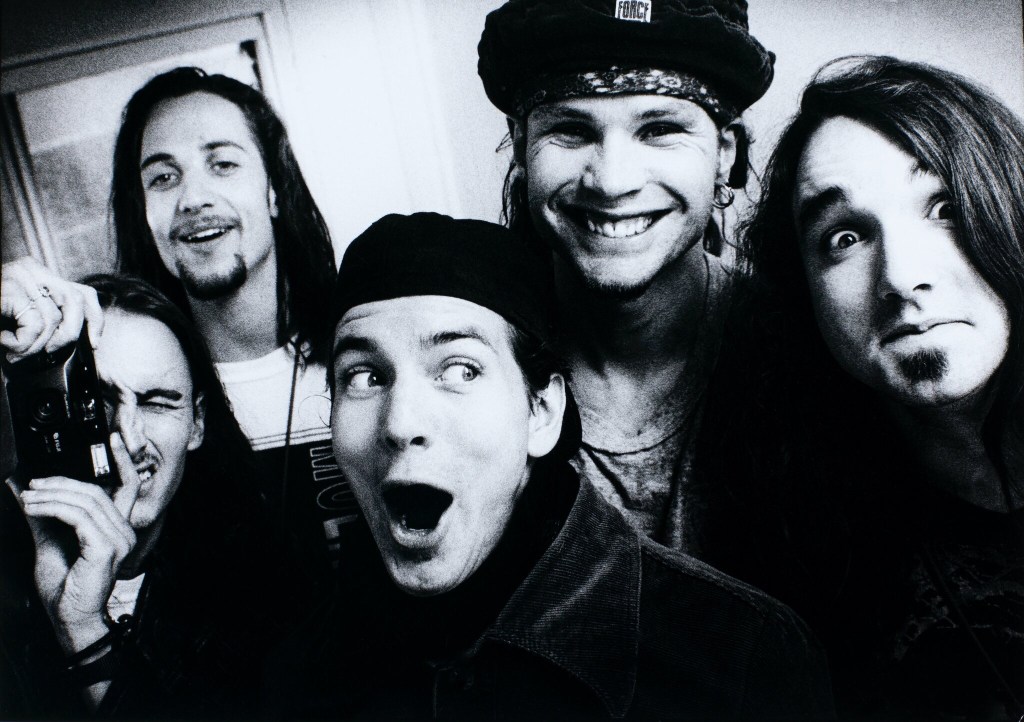
A fun nineties photo – New York Times
I remember thinking I would’ve loved this band if I was my nephew’s age. Their music was emotional and honest and electrifying. I thought they were closer to his age than mine. I made that assumption based on the fact he related to them so well. I had no idea then that band members are my age and what I heard that day was many of the same rock band influences. The Stones. The Who. Pink Floyd. My beloved Led Zeppelin. More than anything, it had just felt good to be allowed into someone else’s personal space to hear what was currently most important to them. It reminded me of the times my brothers had let me sit quietly with them to listen to their rock albums. Or when they gave me a new cassette of older music because they thought my teenaged taste could use some fine tuning. It’s the feeling of belonging in a moment, just as you are.
“Alive” came on the radio that morning while I was driving to work, just before dawn lit up the sky for another day without my mom. I smiled tentatively and upped the volume to sing along. Who answers? Yeah. That is the question. It was the first time I’d heard a song in a long time that didn’t graze the edges of my grief and make me want to weep. I was only sad when it ended. I wanted that alive feeling back again, no matter how briefly it lasted. After my shift at the bookstore, I went and bought all the Pearl Jam CDs I could find. I stashed them under the driver’s seat and played them every time I was alone in the car. Alive brought me back to their music, but it was “Given to Fly” that reached my heart this time around.
“He could’ve tuned in, tuned in But he tuned out A bad time, nothing could save him Alone in a corridor, waiting, locked out He got up outta there, ran for hundreds of miles He made it to the ocean, had a smoke in a tree The wind rose up, set him down on his knee
A wave came crashing like a fist to the jaw Delivered him wings, “Hey, look at me now” Arms wide open with the sea as his floor Oh, power, oh
He’s flying Whole High, wide, oh…”
There’s many interpretations of what the song is about. Eddie Vedder has only ever said it’s a children’s fable. Recently I learned it might’ve been loosely inspired by my most loved Zeppelin song “Going to California”, which explains a lot. For me it’ll always be about accepting emotional pain and then not allowing it to overcome me. “And he still gives his love, he just gives it away. The love he receives is the love that is saved.” Hearing those words makes me feel stronger and reminds me how fortunate I am to have always been well-loved and supported throughout my life. For that alone I’d say it’s my favourite. Pearl Jam’s music helped me to get back to myself during a very hard time and I’ve never forgotten it. This is my thank you letter to them.
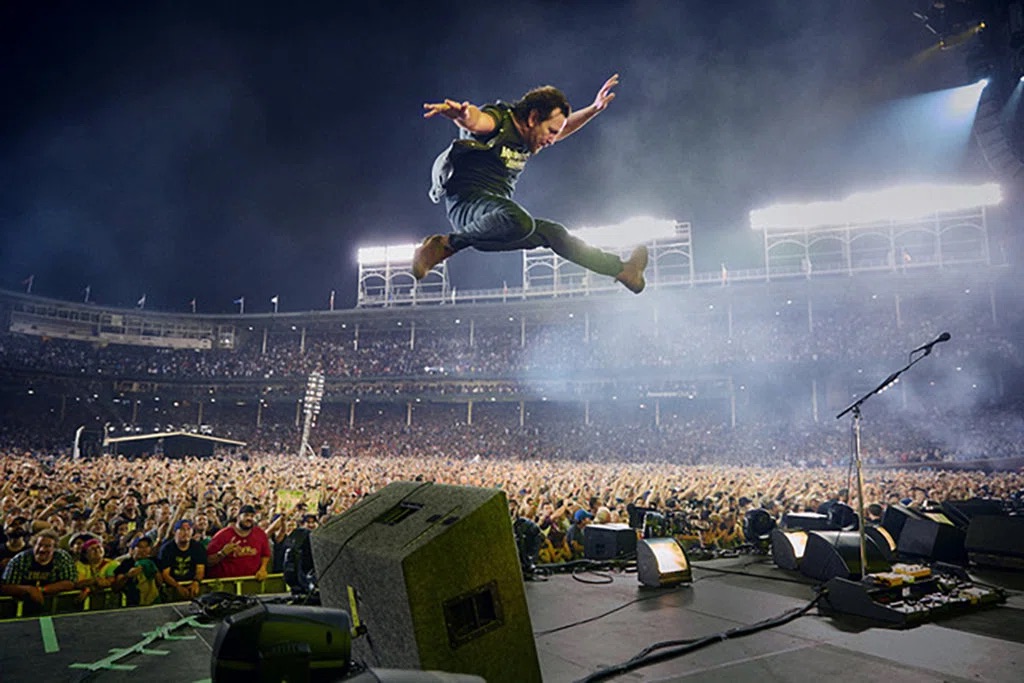
Flying! Photo credit to New York Times, Wrigley Field
I first saw Eddie Vedder sing “Black” live a long time ago in the MTV Unplugged series. He didn’t just sing it, he lived it. For me it’s the most deeply personal song about heartbreak ever written and performed. I can’t begin to count how many times I’ve rewatched that performance, and all the others in the set, since rediscovering Pearl Jam yet again in 2020. Coincidentally right at a time when I needed another emotional lifeline tossed my way. In 2020 I started on the path of making some crucial personal decisions. I was looking for signs that I was doing the right things at a confusing time. Those timeless MTV Unplugged sessions led me to more of their concert performances on Youtube, recorded at different times throughout their thirtysomething years together. I needed to hear these guys again and there they were. They’ve aged, of course, just like me. They’ve grown softer around the edges, less defiant. More mellow. Well, same here. They still have important stories to tell, and so do I.
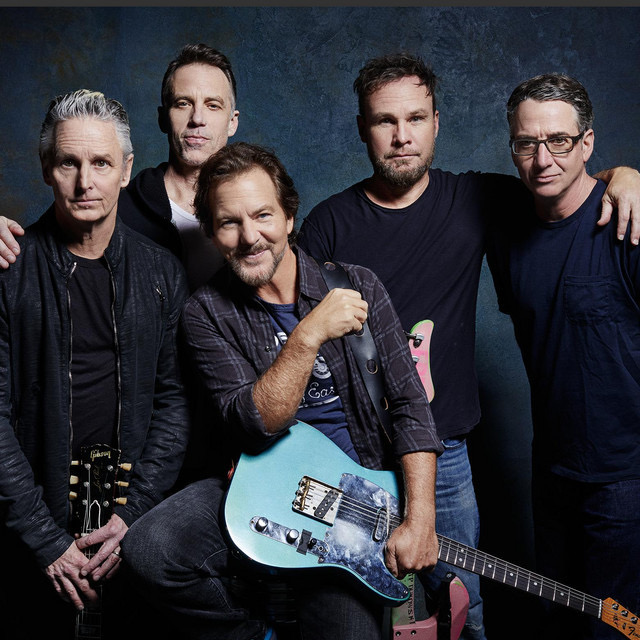
They’re one of the few rock bands whose founding members have managed to stay alive (pun not intended) and together, with the exception of drummers until Matt Cameron came along, and the addition of Hawaiian-born keyboardist Boom Gaspar. They live in the Pacific Northwest and Eddie has a second home in Hawaii. I think their vibe might be warmly familiar to me because of that. Jeff Ament is the great bassist and Stone Gossard is a guitarist and co-lyricist. In my opinion Mike McCready is one of the best and most underrated guitarists of his time. Lead singer and songwriter Eddie Vedder has the soul of a poet and vocals that can be melancholy and exhilarating at the same time. Many of his lyrics are infused with references to the ocean (he’s a longtime surfer) and nature, and the need to be alone sometimes, yet always fully present in the lives of loved ones. All the things that feed my soul too.
Seeing them perform live in real time has been at the top of my bucket list for as long as I’ve had such a list. I don’t care that they’re well into their fifties now because so am I. For sure I wouldn’t have appreciated it quite as much had I seen them perform onstage at the very start. Can you imagine me getting knocked around in a wild mosh pit? Not likely. I always need the elbow room to dance. Rediscovering their music has once again pulled me out of my head, reminding me that things will eventually be okay and sometimes change is out of my control and sometimes it’s controlled only by me.
It was finding Eddie’s background music quote that first got me thinking about the singer-songwriters I loved the most during my youth and still love today. It’s what prompted me to journal those memories and then a little shyly share them in this blog series. All the music throughout my life that has made me want to get up and dance, to sing along, to celebrate, mourn, and weep. Lyrics that have healed my broken heart, filled my soul, and gave me confidence to stand up for myself, to take a sudden turn, and to bravely let go of things that no longer matter.
I could never pick just one of Pearl Jam’s albums as my favourite. I could never pick a most loved book either. For me it’s not just about one story, it’s all the stories I’ve ever read, the entire library of words and thoughts combined. I can tell you which of their songs have helped to ease more recent worries: Given to Fly, The Fixer, Sirens and I Am Mine. You should listen to them. Better yet, watch them because Pearl Jam always delivers a comfortable feeling onstage of living fully in the moment. I hope they make you feel stronger too.
Below, in no particular year order, are Youtube links to favourite performances, along with my thoughts and some interesting song facts I’ve uncovered. I’ve already shared my feelings about “Long Road” in my previous post titled Love and Loss in the 90s. That song belongs to my mother’s memory. These belong to me. The performances are best watched on a laptop or tablet, and, take it from me, their music most thoroughly enjoyed with headphones on. There’s strong emotions in the details.
It’s a wrap for this Background Music blog series. Thanks for joining me on the ride. Perhaps Pearl Jam says it best, “I know I was born and I know that I’ll die, the in between is mine.” ~ I Am Mine.
Given to Fly – One of my favourite performances of this song. Love the energy of the massive crowd in London’s Hyde Park. It’s one of Michael J. Fox’s favourite Pearl Jam songs too. They dedicated it to him and his struggle with Parkinson’s while they performed it during their induction into the Rock and Roll Hall of Fame.
The Fixer – A good reminder that if something’s old “put a bit of shine on it”.
Sirens – With all the turmoil in the world, hearing this one never fails to calm me.
I Am Mine – “The sorrow grows bigger when the sorrow’s denied”.
Daughter/It’s OK – This 2018 performance is in their hometown of Seattle, with some changes in lyrics to reflect turbulent times in American politics. I always believe Eddie when he tells me things will be okay. “Daughter” is about a parent’s mishandling/abuse of their child’s learning disability and the lasting effects that can have.
Black – In my opinion, still the most profoundly poetic song about heartbreak ever written and performed.
Release – “Oh, dear dad. Can you see me now? I am myself. Like you somehow.” xo
Alive – The song that made me first sit up and notice them. This early nineties performance was filmed in a British studio that probably took days to recover from all the angst and long hair flying around.
Better Man – A song about settling, not loving honestly. Fun fact: Bradley Cooper modelled his rock star character in the re-make of “A Star is Born” on Eddie Vedder. I knew it when I saw the movie. You’ll see it when you watch this amazing performance in Madison Square Garden.
Oceans – Eddie has said he wrote this love song to his surfboard. It gets me dreaming about walking the beaches in Hawaii again.
Wishlist – The image in my mind created by “I wish I was the full moon shining off a Camaro’s hood” delights me every time because of long ago summer nights spent cruising around with a friend in her brother’s borrowed Camaro.
Elderly Woman Behind the Counter in a Small Town – Melancholy story about a woman who never left a small town and an old flame who did leave many years ago and by chance comes into her store one day. “Memories like fingerprints are slowly raising.”
Even Flow – A great rock anthem! This video performance of it is absolutely bonkers. Confirmation I wouldn’t have been able to handle their nineties concerts. Band members have said they’ve often feared for Eddie’s life during shows. If you’re interested here’s a video montage of some of his stage climbs and jumps that were captured over the years. Recently I read a funny comment saying that while many musicians were doing heroin, Eddie Vedder must’ve been doing CrossFit training.
Yellow Ledbetter – The lyrics are intentionally incomprehensible to reflect the confusing loss of a brother during the Gulf War and it’s almost impossible to sing along with. In this early version in Mexico the lyrics “I don’t know whether I’m the boxer or the bag” were changed to “I don’t know if my brother is coming home in a box or a bag”. Mike’s guitar solo at the end of the song is always riveting. I love how they all step aside to rest and let him get on with it.
Guaranteed – Oh, this one speaks to me about the need to be on my own sometimes.
Love Boat Captain – “It’s an art to live with pain. Mix the light into grey. Lost nine friends we’ll never know.” Lyrics that include the nine people who were killed when the crowd surged during Pearl Jam’s set in 2000 at the Roskilde Festival in Denmark. Devastated, Pearl Jam quit after that and Eddie Vedder’s idol Pete Townshend of the Who reached out to him after the tragedy because of similar circumstances that happened to his band in 1979. According to Pete Townshend, “When Roskilde happened, I just sent Eddie a two-word message: ‘Don’t leave.’ And they did stay. And I think it was very important that they did.”
Come Back – Sharing the studio version in order to hear the beautiful lyrics more clearly. I can’t get through it without getting choked up.
The Waiting – I’m including this duet with Tom Petty and The Heartbreakers because I’m a longtime fan and it makes me very happy. Eddie’s “Long Way” from his new solo album Earthling is a tribute to Tom Petty’s style of songwriting. I sensed that the first time I heard it, so I wasn’t surprised when he confirmed the inspiration behind the song and many others on the fabulous album during a recently filmed conversation with Bruce Springsteen.

 A Roaring Good Yarn