reading

Book Talk: High Fidelity

“Sentimental music has this great way of taking you back somewhere at the same time that it takes you forward, so you feel nostalgic and hopeful all at the same time.” ― Nick Hornby, High Fidelity

I’ve been on a reading binge lately. This tends to happen more in the summer when it’s light enough to relax on the porch with a book after dinner. Lately I’ve had the urge to revisit both contemporary and classic novels I read a long time ago. Not sure why exactly, though I’ve been doing the same thing with music so maybe it all comes down to age and nostalgia. A couple of weeks ago, I came across Nick Hornby’s novel High Fidelity while browsing the shelves of the same bookstore I used to work at when this book was released in the mid-nineties. I stocked the fiction shelves then and no doubt kept restocking this one at the height of its popularity. Nice that it’s still there.

The narrator Rob is thirty-five, a little older than me the first time I read it, and we had similar taste in music and I suppose we still do. Rob owns a failing record store in London, which reminds me why I never watched the movie version of the book. In the movie John Cusack owns a record store in Chicago. The main appeal of this novel for me is that the characters and setting are delightfully British. Rob’s longtime, live-in girlfriend Laura has just left him and he is both miserable and relieved about it until he begins to search a little deeper for the reasons why all of his relationships have failed so miserably. For once he can’t seem to find refuge from his problems in his huge record collection or by working in his store. Even his two offbeat employees and quirky customers have begun to infuriate him more than normal. The premise reminds me of Hugh Grant in the movie Notting Hill–the way Hugh’s character only stocked travel books and would grumpily chase out visitors who came in asking for popular fiction. Rob does the exact same thing if a customer has what he considers bad taste in music. Since High Fidelity (the novel) came before Notting Hill, is it safe to assume Hornby’s character Rob was the inspiration for Hugh Grant’s reserved bookstore character? Interesting…I hadn’t made that connection until now.

One day Rob takes a hard look around and notices this about his business, “The shop smells of stale smoke, damp, and plastic dust-covers, and it’s narrow and dingy and dirty and overcrowded, partly because that’s what I wanted–this is what record shops should look like, and only Phil Collins’s fans bother with those that look as clean and wholesome as a suburban Habitat–and partly because I can’t get it together to clean or redecorate it.”

Like Rob, I’m not a fan of Phil’s band Genesis, so this paragraph made me chuckle and it probably did in the nineties, too. It also effectively shows us that the state of Rob’s store mirrors the current state of his mind. While he tries to sort out the reasons why Laura suddenly dumped him by visiting former girlfriends who did the same to him over the years, he meets a free-spirited, female American recording artist, who’s just moved to his neighbourhood and performs often at the local pub. In my imagination I kept picturing the character of Marie as a young Joni Mitchell. I wanted much more of Marie’s background story! What about her romantic hopes and music dreams? Why doesn’t any of that matter when her character is pivotal to the plot? Anyway, Rob and Marie begin a casual relationship, and while it seems it’s what Rob has always wanted–no strings, no commitments–he soon realizes that the things his ex-girlfriend Laura wants (marriage, kids, stability, soft rock music, etc.) aren’t quite so terrifying to him anymore. Can he get Laura back or is it already too late? (No ending spoilers here.)

Rereading this book was a different, more thoughtful experience. Rob’s snarky attitude and self-absorption certainly irritated me now, although I found myself laughing all over again at his sarcastic observations about pop culture and some of the music that came out of the eighties and nineties. I still admire the way Nick Hornby wrote this book–with unflinching, biting honesty. He doesn’t turn Rob into a likeable guy as the character searches for deeper self-awareness. He keeps Rob grumpy, neurotic, and reluctant to change. I still rooted for him, though, because change at every stage in life is hard. I like to think even Rob in his later years would find his younger self irritating and sometimes cringy. Like reading a stream of consciousness page in an old tattered diary penned a lifetime ago. Before we discover we’re not the centre of the universe.
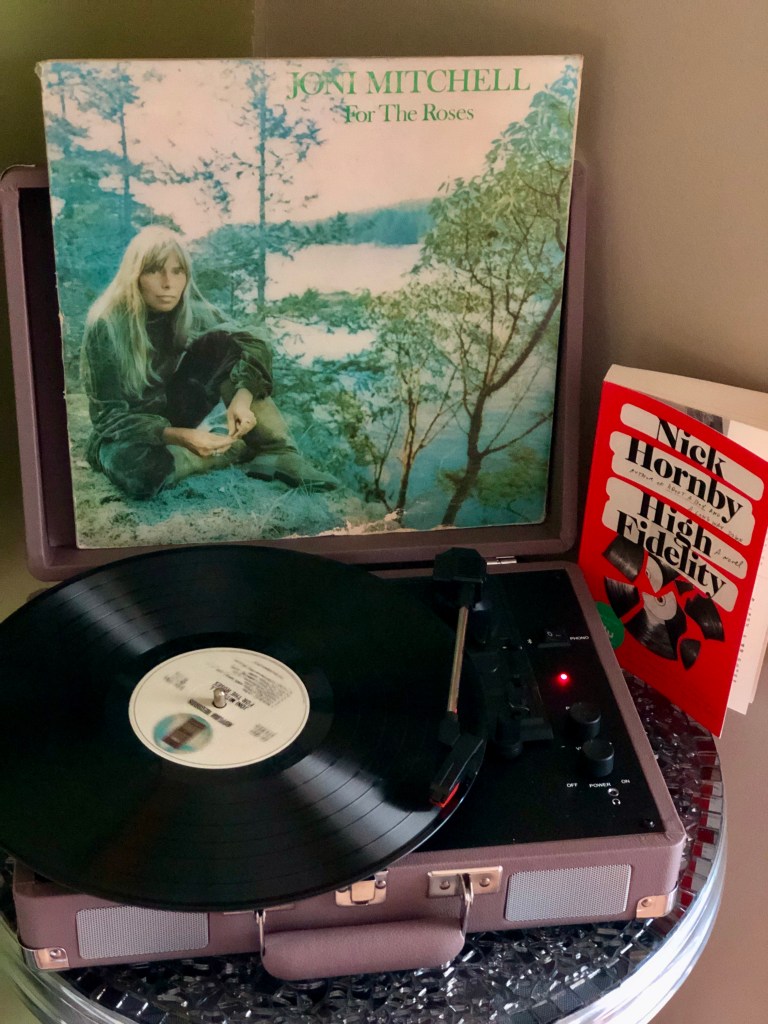
It feels like a mellow Joni Mitchell kind of afternoon as I write this post. I’m not sure if Rob the record store owner would chase me out for asking for this amazing album, but I wouldn’t hesitate to debate him (or anyone) about the genius of Joni’s songwriting. That’s the beauty of the albums we treasure, each song is a marker tucked between the pages of some of our fondest memories.

Rob asks us this, “Is it wrong, wanting to be at home with your record collection? It’s not like collecting records is like collecting stamps, or beermats, or antique thimbles. There’s a whole world in here, a nicer, dirtier, more violent, more peaceful, more colourful, sleazier, more dangerous, more loving world than the world I live in; there is history, and geography, and poetry, and countless other things I should have studied at school, including music.” 
reading

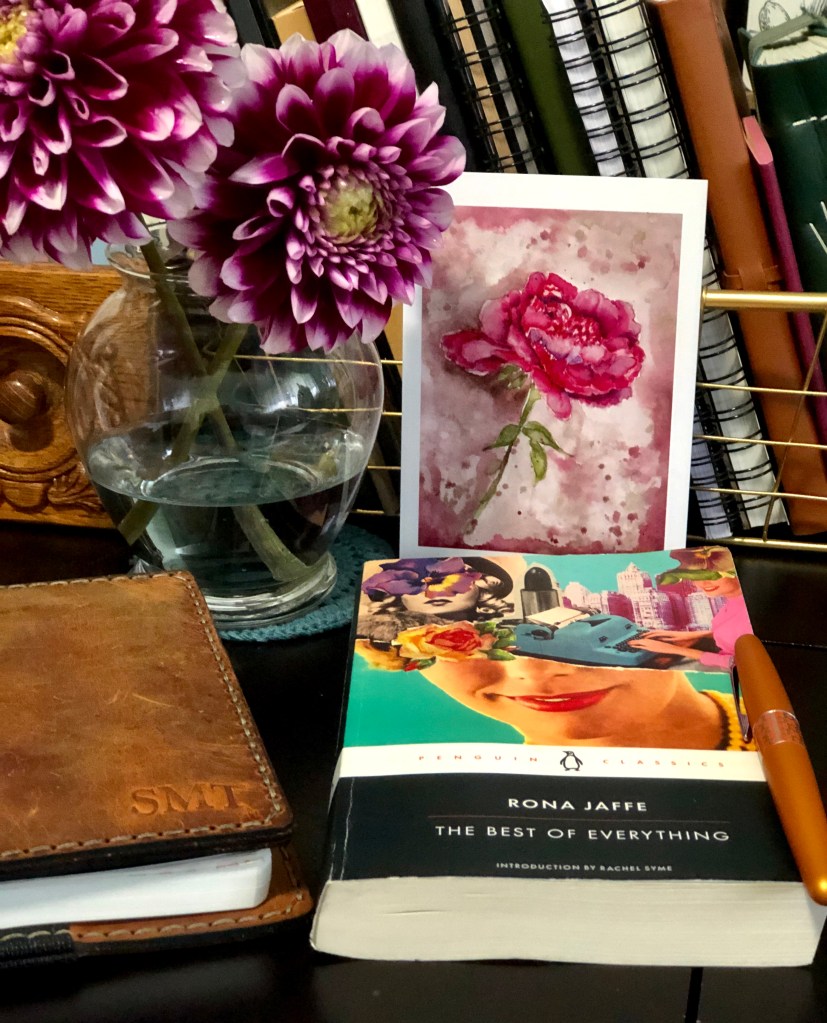
Book Talk: The Best Of Everything

“It was funny, she thought, that before she had ever had a job she had always thought of an office as a place where people came to work, but now it seemed as if it was a place where they also brought their private lives for everyone else to look at, paw over, comment on and enjoy.” ~ Rona Jaffe, The Best of Everything

“The Best of Everything” by Rona Jaffe was published in 1958. Jaffe herself worked at a publishing house in her early twenties that was the model for the fictional Fabian Publications in this story beginning in 1952. She relied on her own background and her young life experiences to write the novel in her mid-twenties, but also interviewed many of her peers about their individual experiences working at the time as secretaries and assistants in New York City. The result is a well-developed and portrayed cast of twentysomething, female characters: Caroline, April, Gregg, Barbara and Mary Agnes, each with their own ideals, career pursuits, dating mishaps, and dramatic struggles within sexist workplaces, while appearing to live glamorously in crummy apartments with only big dreams and no money to show for it.

The novel was long out of print until, rumour has it, Don Draper was seen reading it in his pyjamas in an episode of “Mad Men”. Perhaps that’s what prompted Penguin to eventually reissue it as 65th-anniversary classics edition. It’s the gorgeous cover art (by Michelle Thompson) of this particular edition that caught my eye and reminded me that I’d read it in my teens, twenty or so years after it’d been published. I didn’t have any lasting memories of it until I picked it up again just last week and found myself hooked from the first paragraph: “You see them every morning at a quarter to nine, rushing out of the maw of the subway tunnel, filing out of Grand Central Station, crossing Lexington and Park and Madison and Fifth avenues, the hundreds and hundreds of girls. Some of them look eager and some look resentful, and some of them look as if they haven’t left their beds yet.”

Strong imagery for anyone who has ever had to commute long distance by transit in the wee hours of the morning, just to make it to work or school by eight or nine o’clock. For a brief time in my late teens–at the start of the eighties–I commuted by bus to downtown Vancouver five days a week from way out in the burbs to an office job I needed but hated. There wasn’t rapid transit in my area quite yet and this was not my dream job. Thankfully, I soon found an office job closer to home; also not an ideal situation, but it paid the bills a little better and prevented me from getting up every weekday morning at 5 on the dot. One time while commuting that very long way to the downtown core, I managed to get a spot in a bench seat that ran sideways and faced the open aisle at the front of the tightly packed bus. I used to fight to stay awake, terrified I’d miss my stop and end up alone in the far side of the city and, even worse, late for work. It always got harder to sit upright once the bus reached the freeway and there weren’t regular stops to jolt passengers out of their restless, forward head-bobbing.

On this particular morning, I’d stayed out too late with friends the evening before and therefore only had myself to blame when I woke up suddenly on hands and knees in the middle of the aisle. I was too shocked to be embarrassed at first, until I saw others around me snickering and pointing. Dazed and also dying a little inside, I struggled to get up off my knees in a suit skirt and heels. A kindly, older gentleman rose from his seat to help me up in the speeding, swaying bus and I still remember what he said, “Don’t sweat it, honey, we’ve all been there before.” Now I still can’t be sure if he meant on hands and knees dying of embarrassment or so exhausted in the moment that the only way was down. Regardless, it’s a fitting statement for how I felt while reading this novel again–we’ve all been there before.

And if we haven’t been there before, then that’s probably due in part to women like the friends group in this novel, who struggled and fought professionally to be taken seriously or paid even half as well as their male co-workers and superiors. At the time there were only two ways out of that particular rat race, either over it by getting married or through it by sheer guts and tenacity. I couldn’t put this book down. Yes, I cringed at some of the outdated language and viewpoints, but I felt empathy for each of the characters in a strong, emotional way I haven’t found lately in some of the newer fiction I’ve been reading. I doubt I felt so emotionally invested when I first read it years ago. I think it may have been considered a scandalous kind of read once upon a time. This time it was like looking at an authentic black and white snapshot, one you stare at in amazement, thinking how mature and sophisticated young people seemed back in the day. Like they had it all figured out. One chapter into this book and you remember (or realize) they didn’t and circumstances could be truly heartbreaking for everyone involved.

Note: highly recommend the Penguin Classics black and white edition, published in 2023. Not only is the cover lovely, the introduction by Rachel Syme is rich in background information about the book and includes a foreword written in 2005 by the late Rona Jaffe.

reading

Book Talk

Emily Wilde’s Encyclopaedia of Faeries by Heather Fawcett

My rating: 4 of 5 stars


I don’t often read fantasy novels, so I didn’t expect to like this book as much as I did. I was pleasantly surprised to discover the author lives in my neck of the woods, on Vancouver Island.

It’s a cute, cozy fantasy about a young, introverted Cambridge professor named Emily Wilde, who embarks on her toughest field work yet: collecting data during the harshest part of winter about the illusive faeries residing on a remote Scandinavian island. Emily is writing the world’s first encyclopedia of faerie lore. She’s a genius scholar, engrossed in her life’s work, and doesn’t have time to make friends with the quirky human townsfolk, who seem to have more secrets than the Hidden Ones themselves. With only her dog Shadow for companionship, she gets straight to work, fighting the frozen elements at every turn. Things are moving along fairly well until her handsome and mysterious academic rival arrives unexpectedly all the way from Cambridge to offer his assistance in her research.

Wendell Bambleby (love his name!) is the bane of Emily’s existence. She suspects he’s trying to ride the coattails of her hard work, since she already knows he’s lazy, yet insufferably likeable to everyone except her. It isn’t long before he’s charmed the townsfolk and at the same time muddled all of Emily’s research. Exactly who is this strange, enigmatic man and why is he determined to take care of her? This becomes the biggest mystery of all–will they remain scholarly rivals or is there something magical going on between them?

The pace was slow-going for me at first, but quickly picked up once Wendell arrived on the scene and the characters became more interesting and their witty banter entertaining. I didn’t know this is the start of an ongoing Emily Wilde series, which would explain why the pace was slow at first and the ending felt rushed. A light, whimsical story to read before bed. Now I’ll wait patiently for the second book.

I finished it last night, while my reading companion loudly snored. Will I have time to squeeze in one more book before the end of February? I decided to include this book review as a blog post rather than just as a sidebar link to my Goodreads account. Please let me know if you’d enjoy seeing Book Talk as a regular short feature here. I read a variety of fiction and nonfiction and always enjoy chatting about books.

Happy reading! ~Sue

View all my reviews

reading

Somewhere Else

We were walking toward the fountain, the epicenter of activity, when an older couple stopped and openly observed us. Robert enjoyed being noticed, and he affectionately squeezed my hand. “Oh, take their picture,” said the woman to her bemused husband, “I think they’re artists.” “Oh, go on,” he shrugged. “They’re just kids.” ~ From “Just Kids” by Patti Smith

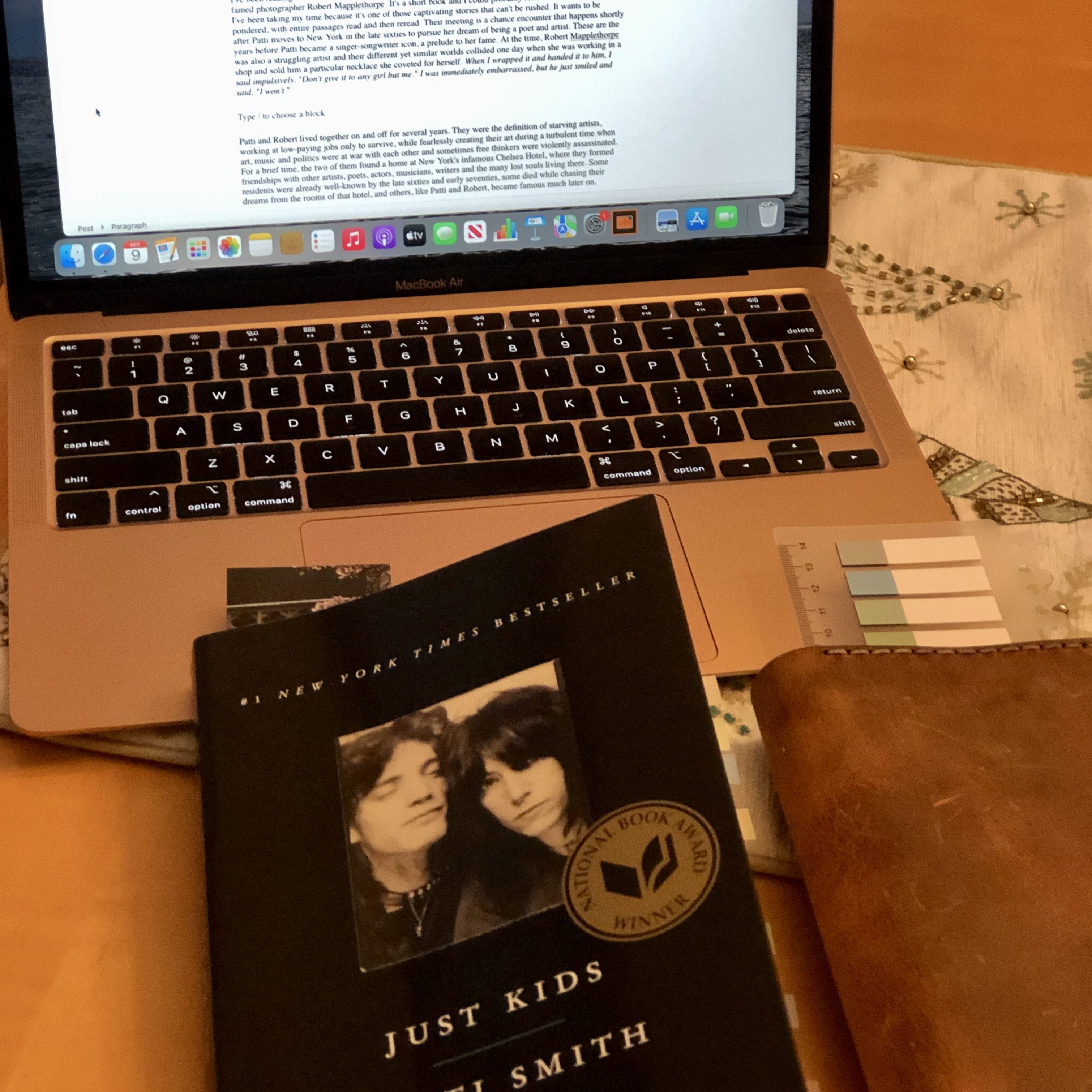
I’ve been reading Patti Smith’s memoir “Just Kids” about an early time in her life during her relationship with famed photographer Robert Mapplethorpe. It’s a short book and I could probably read it in one sitting, but I’ve been taking my time because it’s one of those captivating stories that can’t be rushed. It wants to be pondered, with entire passages read and then reread. Their meeting is a chance encounter that happens shortly after Patti moves to New York in the late sixties to pursue her dream of being a poet and artist. These are the years before Patti became a singer-songwriter icon, a prelude to her fame. At the time, Robert Mapplethorpe was also a struggling artist and their different yet similar worlds collided one day when she was working in a shop and sold him a particular necklace she coveted for herself. When I wrapped it and handed it to him, I said impulsively, “Don’t give it to any girl but me.” I was immediately embarrassed, but he just smiled and said, “I won’t.”

Patti and Robert lived together on and off for several years. They were the definition of starving artists, working at low-paying jobs to survive, while fearlessly creating their art during a turbulent time when art, music and politics were at war with each other and sometimes free thinkers were violently assassinated. For a brief time, the two of them found a home at New York’s infamous Chelsea Hotel, where they formed friendships with other artists, poets, actors, musicians, writers and the many lost souls living there. Some residents were already well-known by the late sixties and early seventies, some died while chasing their dreams from the rooms of that hotel, and others, like Patti and Robert, became famous later on.

Ironically, their individual successes were reached by way of the very mediums they avoided at the time. Patti wanted to be a prolific poet, not a songwriter. It was others who encouraged her to perform, to sing the words she wrote in her notebooks. Robert created collages out of other people’s magazine photographs and claimed to not have the patience to take his own photos to depict his provocative art. Their love story was profound, tumultuous, often joyful, and also heartbreaking. We already know they didn’t stay together forever, but even over time and distance, they continued to support one another, calling each other their star, “the blue star of our destiny”. Early in the book Patti described Robert in one foreshadowing sentence: I thought to myself that he contained a whole universe that I had yet to know.

Patti & Robert at the Chelsea Hotel, NY – photo credit unknown

While Patti and Robert were in their early twenties, chasing their creative dreams in New York, I was a young Canadian child living in the suburbs, running around the neighbourhood with my friends, and also hiding myself in my bedroom for hours with stacks of library books. At the same time I scribbled my thoughts into composition notebooks that eventually formed my own long, rambling stories. “Just Kids” has brought me back to the beginning of my creativity. I didn’t take Patti’s starving artist route in my later writing years. I never really wanted for anything. I grew up comfortably, never going to bed hungry or feeling unloved or yearning to escape. But, like Patti Smith, I was a daydreamer and many times felt misunderstood. She said of herself, I was a dreamy somnambulant child. I vexed my teachers with my precocious reading ability paired with an inability to apply it to anything they deemed practical. One by one they noted in my reports that I daydreamed far too much, was always somewhere else.

I was always somewhere else, too. My paternal grandmother taught me how to read long before I went to school by reading with me all the time. Early on I discovered how to lose myself in a story. We read storybooks together first and then children’s classic novels. Once we completed a book, she never asked me if I enjoyed the story. She always asked me how it made me feel. I didn’t know it at the time, but what a gift she gave me in that simple question. Thinking about that put me directly into the story and set the course on how I view writing today. I observe all art with feeling. I can’t listen to music without thinking about what the lyrics mean to the songwriter and to me. I can’t look at a painting and not wonder what the artist was going through emotionally at the time. I always look beyond the layers to somewhere deeper, somewhere else.

I feel fortunate to have grown up at a time, and in household, where books and movies, art and music were discussed at length. There wasn’t an outside world of knowledge for me to Google. My opinions and interpretations were always my own and I was often encouraged to share them. Patti and Robert’s story has made me long to relive the hours I spent discussing a novel with another bookworm friend over many cups of Red Rose Orange Pekoe tea. How one single observation made me reread chapters because I was convinced I’d missed something important. I feel nostalgic for long ago car rides, trying to decipher lyrics in a song on the radio because I’d always heard it one way, while another passenger heard something else. How many times have I sat in a car in the dark, shivering, as I discussed and dissected a movie just seen in a theatre with a sibling, a best friend or a boyfriend? Countless times. Wondrous times.

These days I–and maybe we–consume and don’t take the time to reflect before we move onto the next interesting thing. I’m reminded of my husband’s grandfather, who lived with us for a short time when we were first starting our lives together. He’d yell upstairs to me from his downstairs suite whenever his failing memory couldn’t provide an answer he needed, usually from a book he read a long time ago. We shared a love of literature and poetry, and maybe we understood each other a little better than most. Kindred spirits. If we’re lucky, we get to meet a few of those over a lifetime. I’d always dig deep to try to remember whatever he was asking because there was no internet then, no external way of fact checking on the spot. I soon grew to understand he wasn’t really searching for an easy answer, anyway. He was looking to relive the experience, the feeling a particular story once gave him. It was his way of asking me to come downstairs to talk about it with him without telling me that’s what he needed. Companionship. Understanding. A brief moment somewhere else.

As this year comes to an end, I once again find myself surrounded by stacks of books, notebooks, and manuscript pages. I don’t think it’s a coincidence that I find myself here again. Back at the beginning, to the daydreamer I used to be. I rediscovered this year it’s an important part of me and I’ve been missing that key to myself. December feels like the perfect time to savour Patti’s words–her voice calling up from downstairs, reminding me to take more time to let my mind wander and ponder before moving onto the next interesting thing.

It occurred to me looking around at all of your things and your work and going through years of work in my mind, that of all your work, you are still your most beautiful. The most beautiful work of all. ~ Patti Smith, “Just Kids”

Just Kids by Patti Smith

reading

July & Joni

I’ve looked at life from both sides now, from win and lose and still somehow, it’s life’s illusions I recall. I really don’t know life at all. ~ Joni Mitchell, Both Sides Now.

The first song that springs to mind when I think about life in the early 1970s is “Both Sides Now”. Originally recorded by Judy Collins, the song was written by Canadian singer-songwriter Joni Mitchell and, in my opinion, should only ever be performed by Joni. If you listen to it now, then listen to Joni sing it and you will hear the clear poetic difference in how she feels her own words.

The meaning of this song for me represents childhood slipping away. Hearing Joni sing it always makes me teary, and it shifts my mind back inside long ago summer days spent zipping along the streets of suburbia with neighbourhood friends. Black Cat gum and brand-new white Keds, grass-stained within hours of taking them out of the box. A pocket transistor radio strapped with hair elastics to the plunging handlebars of my sparkly purple Mustang banana-seat bicycle, tinnily blasting the top ten CFUN summer hits in my wake. The earthy tar smell of hot black topped pavement melting in July. Hopscotch, kick ball, and red rover. Flimsy roller skates that tighten around shoes with a special key that I wore on a string around my sun-warmed neck. For me, all of this nostalgia and more are in the lyrics of Both Sides Now. Even the opening line “rows and flows of angel hair” is a tender reminder that I’d first misinterpreted it as bowls and bowls of angel hair. Perhaps I’d been hoping pasta was on the supper menu that evening.

Although Both Sides Now is Joni’s song of my childhood, my longtime favourite has always been A Case of You from her iconic album Blue. It’s rumoured to be written about her break-up with either Graham Nash or Leonard Cohen. I like to think it’s about Cohen because it doesn’t get more Canadian than that. The opening verses are heartbreak wrapped in biting savagery and I adore it:

“Just before our love got lost you said
I am as constant as a northern star
And I said, ‘Constantly in the darkness
Where’s that at?
If you want me I’ll be in the bar’

On the back of a cartoon coaster
In the blue TV screen light
I drew a map of Canada
Oh, Canada
With your face sketched on it twice…”

Recently I came across an article written about a new novel that’s loosely inspired by the early rise of Joni Mitchell’s career and her love affair with singer James Taylor. Of course I had to read it! Songs in Ursa Major by Emma Brodie (publisher: Alfred A. Knopf, 2021) begins in the year 1969 at a fictional folk music festival where we are first introduced to local singer Jane Quinn and her band the Breakers. Jane and the band are the last-minute replacement performers on the main stage after the headline performer, folk singer Jesse Reid, is injured in a motorcycle accident on his way to the festival.

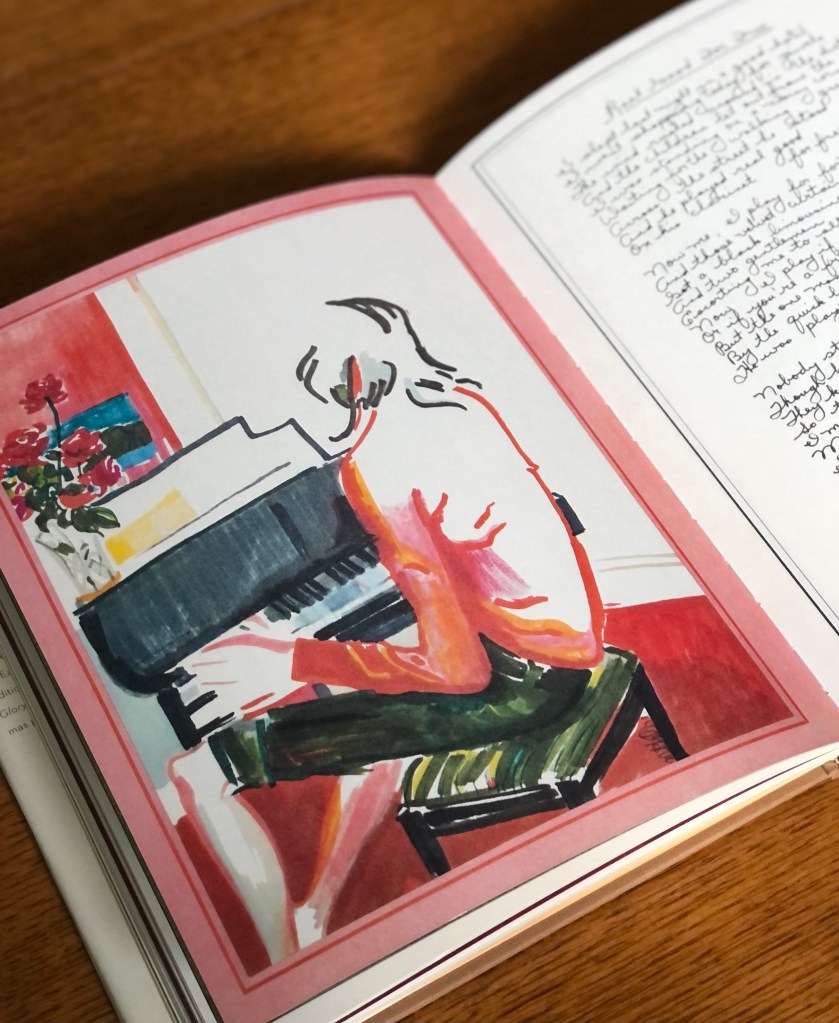
“James Taylor” by Joni Mitchell from her book Morning Glory on the Vine

Jane and Jesse develop a relationship while he is recovering from his injuries that first begins as a shared love of songwriting and quickly develops into a passionate, often torturous love affair that spans many years. The story follows Jane’s rocky ride in the 1970s music industry and her deeply personal relationships with Jesse, her band members, and her family. All of this unfolds around her desire to be recognized for her talent and still remain in control of her career at a time when women’s opinions were the least heard in a room of male executives.

The heart of this novel is a love story, but the backbone for me is a young woman’s search for the illusive balance between self-fulfillment and obligation to loved ones. I read Songs in Ursa Major in one day because I had to know what becomes of Jane from the first pages when she steps barefooted onto the stage and her life instantly changes. I related so much to this feisty character and her determination to remain true to her young self.

I kept thinking about Joni Mitchell’s country-inspired hit You Turn Me On I’m A Radio while reading Jane’s story. Music industry execs want Jane to write catchy hits for the radio instead of honest music inspired by her life experiences. Joni’s response to the same request in her career famously mocked her recording label manager with these lyrics:

“I’m a broadcasting tower
Waving for you
And I’m sending you out
This signal here
I hope you can pick it up
Loud and clear
I know you don’t like weak women
You get bored so quick
And you don’t like strong women
‘Cause they’re hip to your tricks
It’s been dirty for dirty
Down the line
But you know I come when you whistle
When you’re loving and kind
But if you’ve got too many doubts
If there’s no good reception for me
Then tune me out, ’cause honey
Who needs the static
It hurts the head…”

The complete lyrics are here.

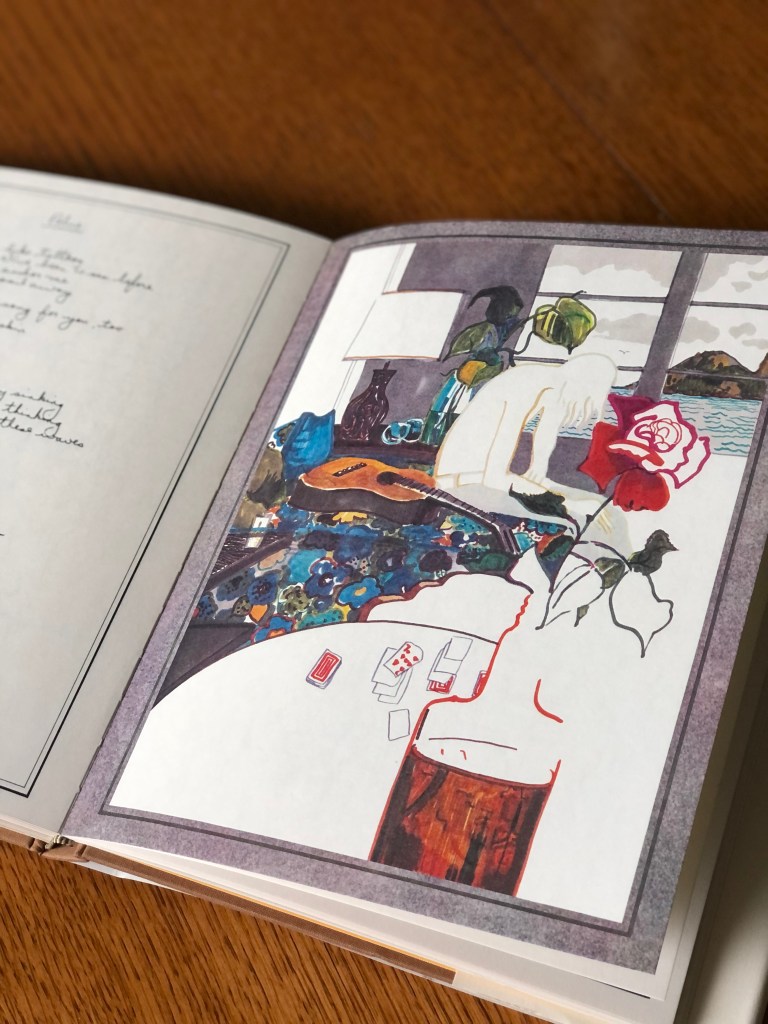
Untitled (and my favourite drawing) by Joni Mitchell: Morning Glory on the Vine

Another book I enjoy immensely is Joni Mitchell’s Morning Glory on the Vine: Early Songs & Drawings (publisher: Houghton Mifflin Harcourt, 2019). In 1971, as her groundbreaking album Blue became a commercial success all around the world, Christmas came along and Joni struggled with what presents to give her nouveau riche friends. In the end she decided to give them each a handmade book filled with a collection of her songs, poems and drawings that she called “The Christmas Book”. The edition remained private amongst friends until it was recently published, a present to all of her fans.

There have been many creative influences in my life and sometimes hearing a song or reading passages from a poem or book reminds me to be thankful for those brave souls who put their whole hearts into words, even knowing that some might not understand a single word of it.

Joni Mitchell says it best in a letter to her friends, “Well I know you can’t really knock something till you know it–inside and out–all sides. And I find that then, when you understand it, it’s hard to knock it. You just feel it–laugh or cry.”