
“Sentimental music has this great way of taking you back somewhere at the same time that it takes you forward, so you feel nostalgic and hopeful all at the same time.” ― Nick Hornby, High Fidelity
I’ve been on a reading binge lately. This tends to happen more in the summer when it’s light enough to relax on the porch with a book after dinner. Lately I’ve had the urge to revisit both contemporary and classic novels I read a long time ago. Not sure why exactly, though I’ve been doing the same thing with music so maybe it all comes down to age and nostalgia. A couple of weeks ago, I came across Nick Hornby’s novel High Fidelity while browsing the shelves of the same bookstore I used to work at when this book was released in the mid-nineties. I stocked the fiction shelves then and no doubt kept restocking this one at the height of its popularity. Nice that it’s still there.
The narrator Rob is thirty-five, a little older than me the first time I read it, and we had similar taste in music and I suppose we still do. Rob owns a failing record store in London, which reminds me why I never watched the movie version of the book. In the movie John Cusack owns a record store in Chicago. The main appeal of this novel for me is that the characters and setting are delightfully British. Rob’s longtime, live-in girlfriend Laura has just left him and he is both miserable and relieved about it until he begins to search a little deeper for the reasons why all of his relationships have failed so miserably. For once he can’t seem to find refuge from his problems in his huge record collection or by working in his store. Even his two offbeat employees and quirky customers have begun to infuriate him more than normal. The premise reminds me of Hugh Grant in the movie Notting Hill–the way Hugh’s character only stocked travel books and would grumpily chase out visitors who came in asking for popular fiction. Rob does the exact same thing if a customer has what he considers bad taste in music. Since High Fidelity (the novel) came before Notting Hill, is it safe to assume Hornby’s character Rob was the inspiration for Hugh Grant’s reserved bookstore character? Interesting…I hadn’t made that connection until now.
One day Rob takes a hard look around and notices this about his business, “The shop smells of stale smoke, damp, and plastic dust-covers, and it’s narrow and dingy and dirty and overcrowded, partly because that’s what I wanted–this is what record shops should look like, and only Phil Collins’s fans bother with those that look as clean and wholesome as a suburban Habitat–and partly because I can’t get it together to clean or redecorate it.”
Like Rob, I’m not a fan of Phil’s band Genesis, so this paragraph made me chuckle and it probably did in the nineties, too. It also effectively shows us that the state of Rob’s store mirrors the current state of his mind. While he tries to sort out the reasons why Laura suddenly dumped him by visiting former girlfriends who did the same to him over the years, he meets a free-spirited, female American recording artist, who’s just moved to his neighbourhood and performs often at the local pub. In my imagination I kept picturing the character of Marie as a young Joni Mitchell. I wanted much more of Marie’s background story! What about her romantic hopes and music dreams? Why doesn’t any of that matter when her character is pivotal to the plot? Anyway, Rob and Marie begin a casual relationship, and while it seems it’s what Rob has always wanted–no strings, no commitments–he soon realizes that the things his ex-girlfriend Laura wants (marriage, kids, stability, soft rock music, etc.) aren’t quite so terrifying to him anymore. Can he get Laura back or is it already too late? (No ending spoilers here.)
Rereading this book was a different, more thoughtful experience. Rob’s snarky attitude and self-absorption certainly irritated me now, although I found myself laughing all over again at his sarcastic observations about pop culture and some of the music that came out of the eighties and nineties. I still admire the way Nick Hornby wrote this book–with unflinching, biting honesty. He doesn’t turn Rob into a likeable guy as the character searches for deeper self-awareness. He keeps Rob grumpy, neurotic, and reluctant to change. I still rooted for him, though, because change at every stage in life is hard. I like to think even Rob in his later years would find his younger self irritating and sometimes cringy. Like reading a stream of consciousness page in an old tattered diary penned a lifetime ago. Before we discover we’re not the centre of the universe.
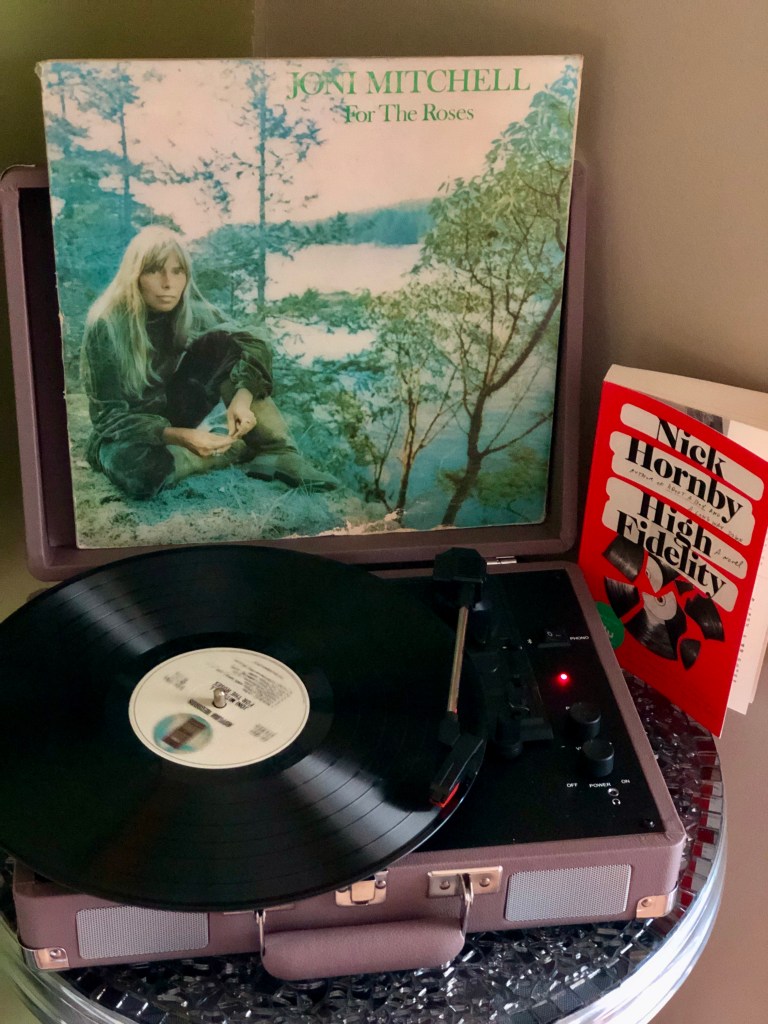
It feels like a mellow Joni Mitchell kind of afternoon as I write this post. I’m not sure if Rob the record store owner would chase me out for asking for this amazing album, but I wouldn’t hesitate to debate him (or anyone) about the genius of Joni’s songwriting. That’s the beauty of the albums we treasure, each song is a marker tucked between the pages of some of our fondest memories.
Rob asks us this, “Is it wrong, wanting to be at home with your record collection? It’s not like collecting records is like collecting stamps, or beermats, or antique thimbles. There’s a whole world in here, a nicer, dirtier, more violent, more peaceful, more colourful, sleazier, more dangerous, more loving world than the world I live in; there is history, and geography, and poetry, and countless other things I should have studied at school, including music.”
 A Roaring Good Yarn