“No matter what your age or your life path, whether making art is your career or your hobby or your dream, it is not too late or too egotistical or too selfish or too silly to work on your creativity.” ~ Julia Cameron from The Artist’s Way
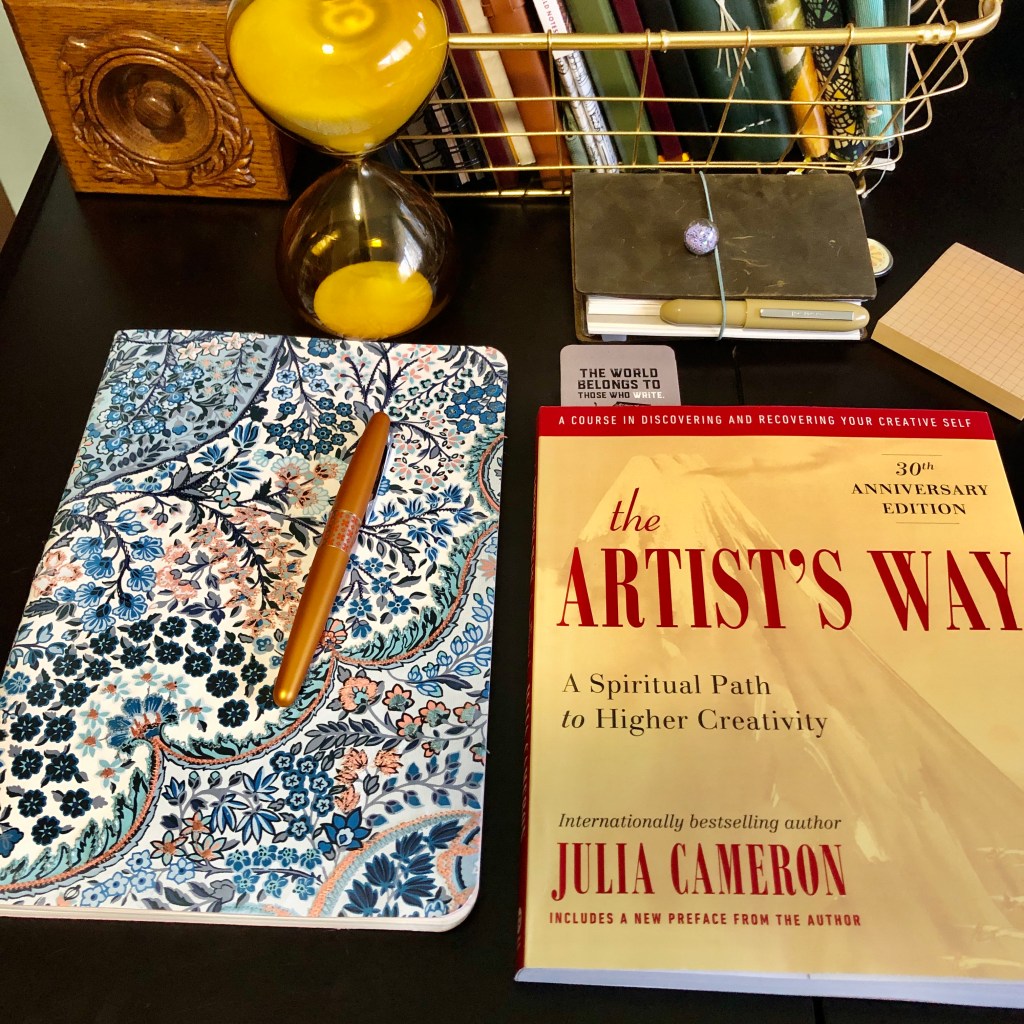
Julia Cameron’s book The Artist’s Way: A Spiritual Path to Higher Creativity was recommended to me by a writer friend when it was first published in the early nineties. At the time she had teenagers and I had toddlers and I remember thinking, I barely have a thought that’s my own! How can I possibly fill three notebook pages every morning with whatever is going on inside my head? But I’ve always liked a challenge and I wanted to be more creative and less task-driven, so I borrowed my friend’s well-used copy of the book. Essentially it gives you exercises and a long pep talk to help you overcome the beliefs and fears that can inhibit the process in whatever creative medium you’re pursuing. Sounds simple enough, doesn’t it? I gave it my best shot for about a week, until the pages began to fill up with to-do lists and doodles, Dear Diary-like entries, and maybe a rant or two. It was the right book, it just wasn’t the right time for me to fully engage with it. When the thirtieth anniversary edition of this same book recently found its way back into my hands, I casually flipped it open to read the inside flap and the first sentence I read is the one that’s quoted above. Then I thought, I need this right now.
So I read it, cover to cover this time. And I quickly learned that I don’t need to explore every aspect of it. I don’t need to do every exercise and keep consistent creative check-ins. What I have been trying to do, though, is write daily Morning Pages. Julia Cameron capitalizes the two words throughout the book to stress their importance, I suspect, and now I find myself doing the same with a kind of reverence for the practice because I’m seeing positive results. What are Morning Pages? Here’s some quotes about that from from the book: “Three pages of longhand writing, strictly stream-of-consciousness…These daily morning meanderings aren’t meant to be art or even writing…They might also be called a brain drain.” In more modern phrasing, it’s basically a brain dump. A way to clear the mess on the floor to get to the comfy furniture. I’ll be honest, I rarely fill three pages. Usually two, sometimes less. I don’t force the process, or at least I haven’t so far. Writing is hard enough without adding the pressure to perform on command.
In the beginning I wondered why longhand writing and not a keyboard now that we live fully in a digital world and not suspended in 1992. Here’s what I think: a written sentence can’t be deleted. Sure, it can have a line drawn through it or if in pencil erased almost invisibly from the page. Just the process of putting a line through a sentence or a word made me rethink wanting to get rid of it in the first place. It might be important, I considered, maybe even the truth of the matter. According to Julia, “Morning Pages get us beyond our Censor. Beyond the reach of the Censor’s babble we find our own quiet centre.” Something else occurred to me. What if one morning happens to be particularly busy? Should I write Night Pages instead? Once I became fully engaged in the routine, I realized mornings offer the freshest insights and I should probably get up a half an hour earlier to stick with the program. By nighttime our weary thoughts have become clouded by the day’s experiences and the many injustices of the world. The morning is full of creative possibilities waiting to unfold. The following paragraph is the uncensored ramblings I wrote in my notebook on the first morning.
“I tried reading The Artist’s Way when the book first came out thirty years ago. I was writing a lot then. So many ideas kept coming at me from all directions and I needed advice on how to organize them all. Not as many ideas come as easily to me these days, and here I am again, a little lost, looking for some kind of direction. A similar scenario, only this time, thirty years later, I have more time and energy to focus on writing. My younger self had very little time to sit alone with deeper thoughts and imaginings. I was raising a family, working, keeping up the house, and worrying about the diminishing health of ageing parents. I used those precious snippets of writing time wisely and efficiently. I scribbled ideas and dialogue on wrinkled grocery lists and old receipts. I was focused whenever and wherever inspiration struck. In those days I had to get ideas written somewhere before they left my mind for good. There was no other choice; get it down or forget about it. I have decided what I lack at the moment is the creative discipline I had at thirty, and again more recently when I wrote a novel in just a little over a year’s time. Discipline yourself. Just get the words down, even if they’re garbage. Somehow it feels more important than ever to sort out the direction I want to go. After pouring myself into that more recent novel, I realize now, with time and distance from the work, that I repeated many of the same mistakes I’ve made in the past when it comes to trying to get my stories published. I know what those mistakes are and I’ve allowed the Censor to block future work because of them. So here goes. Day one of Morning Pages. Let’s see what I have to tell myself. I hope it makes some sense.”
Whoa. That is a lot of rambling to process. While The Artist’s Way encourages you not to reread your stream-of-consciousness thoughts, I don’t see the point of a brain dump if you don’t do some careful excavating of it later on. So what is my main takeaway here? Well, it’s not a coincidence that I lost the drive to write around the same time the agent rejections came in. But is it really a rejection when you hear nothing back at all? It feels a lot like being ghosted before you’ve had the chance to meet someone in person. We used to call it being stood-up for a date. Current industry standards say to give the email query letter and first chapter submission about four to six weeks for consideration. If you hear nothing back within that time frame then assume it’s a no and feel free to submit elsewhere. Typically, literary agencies now receive thousands of fiction manuscript queries a week. One or two of those a month might pique interest and get a response–other than the automated received and thanks for submitting notification. Don’t call us, we’ll call you. Or not. The odds are solidly stacked against writers long before we work up the nerve to press the email send button. To be fair, so far I’ve only submitted two agent queries over the span of several months before making the executive decision to give myself time to reevaluate the process. I know myself very well at this point in my life–both the person and the writer. It’s not the fear of rejection holding me back now, it’s the niggling feeling that something isn’t right. Maybe this isn’t the novel I am supposed to put out into the world. Maybe it’s a steppingstone to the writing I can be most proud of. I’ve already proven to myself that I can do it. I can start at the beginning and keep on going page after page until I finally type The End. And I can keep editing and rewriting this same book until I have nothing left to add and nothing more to say. But is that what I really want to do?
In the rom-com movie You’ve Got Mail, after Tom Hank’s big-box bookstore owner character gradually puts Meg Ryan’s small bookstore out of business, he pithily tells her, “It’s not personal, it’s business.” Then Meg (aka Kathleen Kelly) famously informs him, “All that means is that it wasn’t personal to you. But it was personal to me. And what’s so wrong with being personal anyway? Because whatever else anything is, it ought to begin with being personal.” I didn’t get back into writing all these many years later expecting to get published. I suddenly felt compelled to write again and so I did. I spent hours creating characters that I grew to care a great deal about along the bumpy road from points A to B. Now I feel protective over them and fret about how impersonally they’re being received. In real life when we walk into a room full of strangers we don’t expect to be instantly liked by everyone. I suppose we start off hopeful about finding a comfortable connection with a least one person of like mind. Realistically, there has to be some kind of personal interaction to decide whether we want to get to know somebody better or if we don’t. Silence just feels so impersonal to me. Like Kathleen said, it ought to begin with being personal. According to published authors and publishing insiders, you’re supposed to keep submitting query letters to dozens of agents at one time in the hope that a single reader might (fingers crossed) see a spark of something promising in chapter one and ask to see the entire manuscript. Honestly, it’s daunting right now for me to even think about doing that over and over. How do you put something like that out of your mind and push forward on a new project?
Which brings us back to the start of Morning Pages, and before that, how I spent most of this past summer. For a few months I stopped focusing on writing and editing and email queries, and instead reread many of the novels that inspired me to be a better writer, first as a child and then as a young adult. I read Victorian classics too, solely for the joy of reading beautifully written prose, while at the same time getting lost in familiar adventures with what feels like old, trusted friends. It seems to take me twice as long to read the classics compared to contemporary novels because I keep pausing to reabsorb meaningful phrases and dialogue. These are my comfort reads, the kind of dramatic, atmospheric novels that had me rushing through chores all summer like I used to when I was a kid, just to get back to the story again. It was the best thing I could have done for myself, this reconnection to the stories that inspired me as both a reader and a writer. The magical writing that continues to be a source of inspiration for me today. I’m a firm believer that everything falls in place once you’re ready to sit down with yourself enough times to be open to receive the message. So that’s what I’ve been doing most mornings now that autumn is here. I wake up a half hour earlier, make coffee, empty the dishwasher, and feed the dog. Then I open my Morning Pages notebook and sit down quietly with myself until light finds my office window to remind me the day ahead is already unfolding with new possibilities.
“Improve your own writing by reading the work of people you admire.” ~ Oscar Wilde



 A Roaring Good Yarn