
I’ve looked at life from both sides now, from win and lose and still somehow, it’s life’s illusions I recall. I really don’t know life at all. ~ Joni Mitchell, Both Sides Now.
The first song that springs to mind when I think about life in the early 1970s is “Both Sides Now”. Originally recorded by Judy Collins, the song was written by Canadian singer-songwriter Joni Mitchell and, in my opinion, should only ever be performed by Joni. If you listen to it now, then listen to Joni sing it and you will hear the clear poetic difference in how she feels her own words.

The meaning of this song for me represents childhood slipping away. Hearing Joni sing it always makes me teary, and it shifts my mind back inside long ago summer days spent zipping along the streets of suburbia with neighbourhood friends. Black Cat gum and brand-new white Keds, grass-stained within hours of taking them out of the box. A pocket transistor radio strapped with hair elastics to the plunging handlebars of my sparkly purple Mustang banana-seat bicycle, tinnily blasting the top ten CFUN summer hits in my wake. The earthy tar smell of hot black topped pavement melting in July. Hopscotch, kick ball, and red rover. Flimsy roller skates that tighten around shoes with a special key that I wore on a string around my sun-warmed neck. For me, all of this nostalgia and more are in the lyrics of Both Sides Now. Even the opening line “rows and flows of angel hair” is a tender reminder that I’d first misinterpreted it as bowls and bowls of angel hair. Perhaps I’d been hoping pasta was on the supper menu that evening.
Although Both Sides Now is Joni’s song of my childhood, my longtime favourite has always been A Case of You from her iconic album Blue. It’s rumoured to be written about her break-up with either Graham Nash or Leonard Cohen. I like to think it’s about Cohen because it doesn’t get more Canadian than that. The opening verses are heartbreak wrapped in biting savagery and I adore it:
“Just before our love got lost you said
I am as constant as a northern star
And I said, ‘Constantly in the darkness
Where’s that at?
If you want me I’ll be in the bar’
On the back of a cartoon coaster
In the blue TV screen light
I drew a map of Canada
Oh, Canada
With your face sketched on it twice…”
Recently I came across an article written about a new novel that’s loosely inspired by the early rise of Joni Mitchell’s career and her love affair with singer James Taylor. Of course I had to read it! Songs in Ursa Major by Emma Brodie (publisher: Alfred A. Knopf, 2021) begins in the year 1969 at a fictional folk music festival where we are first introduced to local singer Jane Quinn and her band the Breakers. Jane and the band are the last-minute replacement performers on the main stage after the headline performer, folk singer Jesse Reid, is injured in a motorcycle accident on his way to the festival.
Jane and Jesse develop a relationship while he is recovering from his injuries that first begins as a shared love of songwriting and quickly develops into a passionate, often torturous love affair that spans many years. The story follows Jane’s rocky ride in the 1970s music industry and her deeply personal relationships with Jesse, her band members, and her family. All of this unfolds around her desire to be recognized for her talent and still remain in control of her career at a time when women’s opinions were the least heard in a room of male executives.
The heart of this novel is a love story, but the backbone for me is a young woman’s search for the illusive balance between self-fulfillment and obligation to loved ones. I read Songs in Ursa Major in one day because I had to know what becomes of Jane from the first pages when she steps barefooted onto the stage and her life instantly changes. I related so much to this feisty character and her determination to remain true to her young self.
I kept thinking about Joni Mitchell’s country-inspired hit You Turn Me On I’m A Radio while reading Jane’s story. Music industry execs want Jane to write catchy hits for the radio instead of honest music inspired by her life experiences. Joni’s response to the same request in her career famously mocked her recording label manager with these lyrics:
“I’m a broadcasting tower
Waving for you
And I’m sending you out
This signal here
I hope you can pick it up
Loud and clear
I know you don’t like weak women
You get bored so quick
And you don’t like strong women
‘Cause they’re hip to your tricks
It’s been dirty for dirty
Down the line
But you know I come when you whistle
When you’re loving and kind
But if you’ve got too many doubts
If there’s no good reception for me
Then tune me out, ’cause honey
Who needs the static
It hurts the head…”
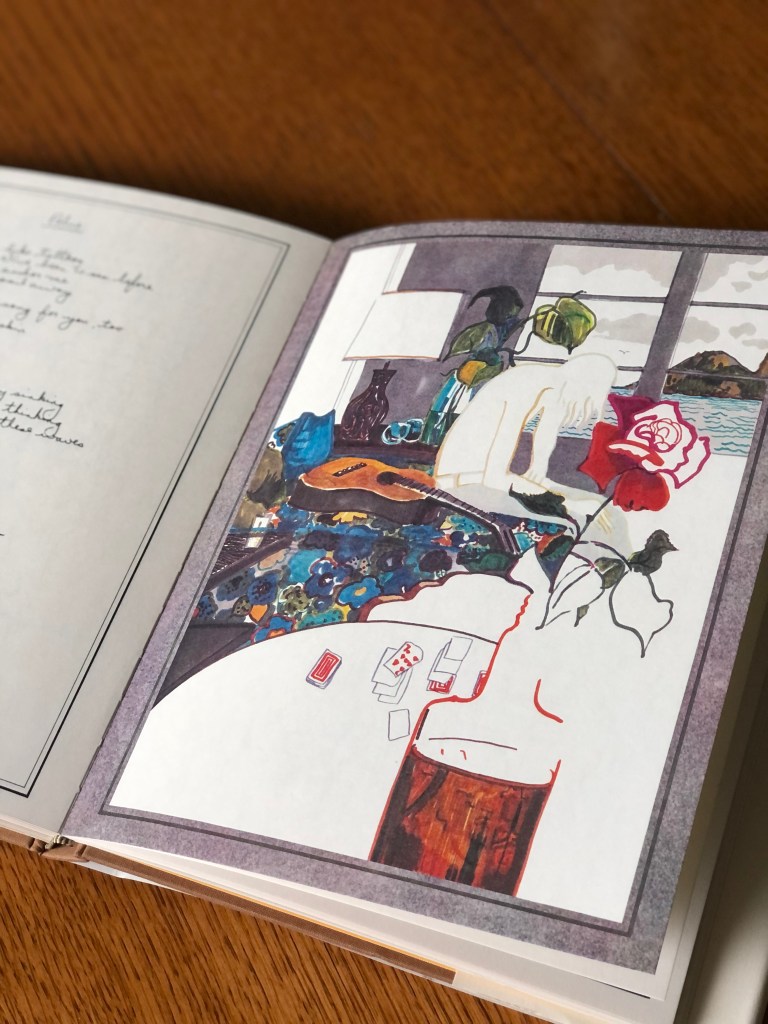
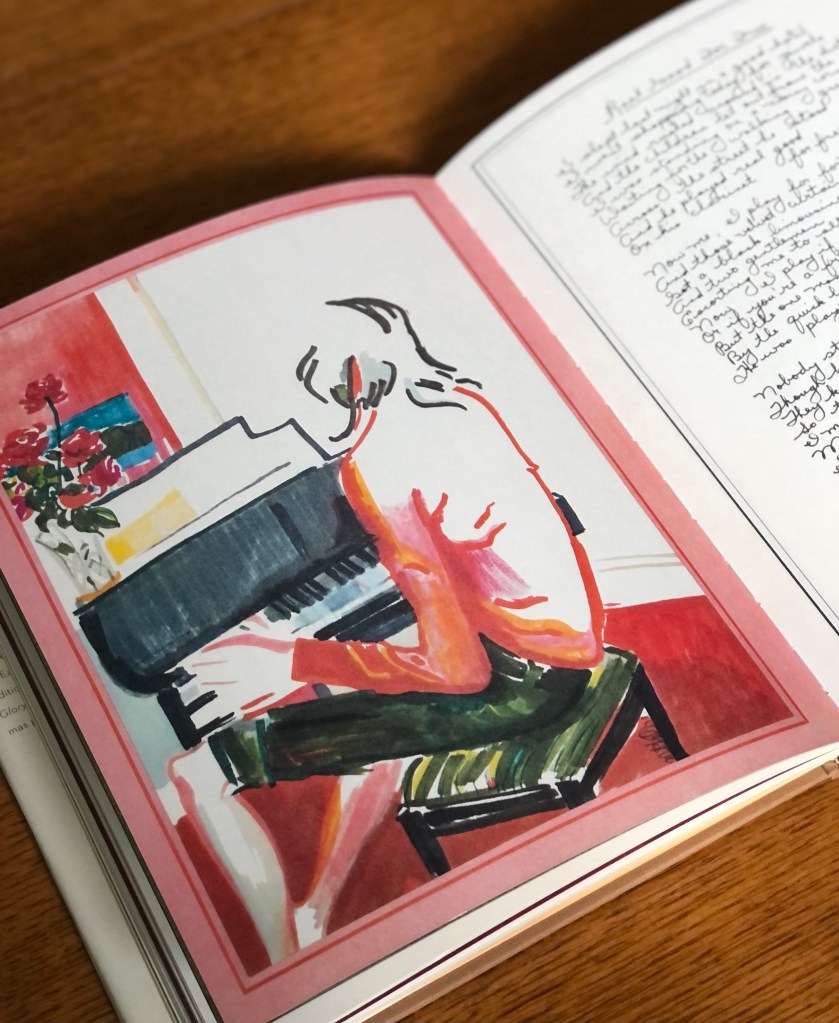
Another book I enjoy immensely is Joni Mitchell’s Morning Glory on the Vine: Early Songs & Drawings (publisher: Houghton Mifflin Harcourt, 2019). In 1971, as her groundbreaking album Blue became a commercial success all around the world, Christmas came along and Joni struggled with what presents to give her nouveau riche friends. In the end she decided to give them each a handmade book filled with a collection of her songs, poems and drawings that she called “The Christmas Book”. The edition remained private amongst friends until it was recently published, a present to all of her fans.
There have been many creative influences in my life and sometimes hearing a song or reading passages from a poem or book reminds me to be thankful for those brave souls who put their whole hearts into words, even knowing that some might not understand a single word of it.
Joni Mitchell says it best in a letter to her friends, “Well I know you can’t really knock something till you know it–inside and out–all sides. And I find that then, when you understand it, it’s hard to knock it. You just feel it–laugh or cry.”
 A Roaring Good Yarn